
VAT Mixed Activity: What You Need to Know
Updated: 2026-09-15
Unsubstantiated VAT deduction when carrying out mixed VAT activity is one of the most common errors identified by the State Tax Inspectorate, so it is important to understand what this means and to ensure that VAT is accounted for and declared correctly.
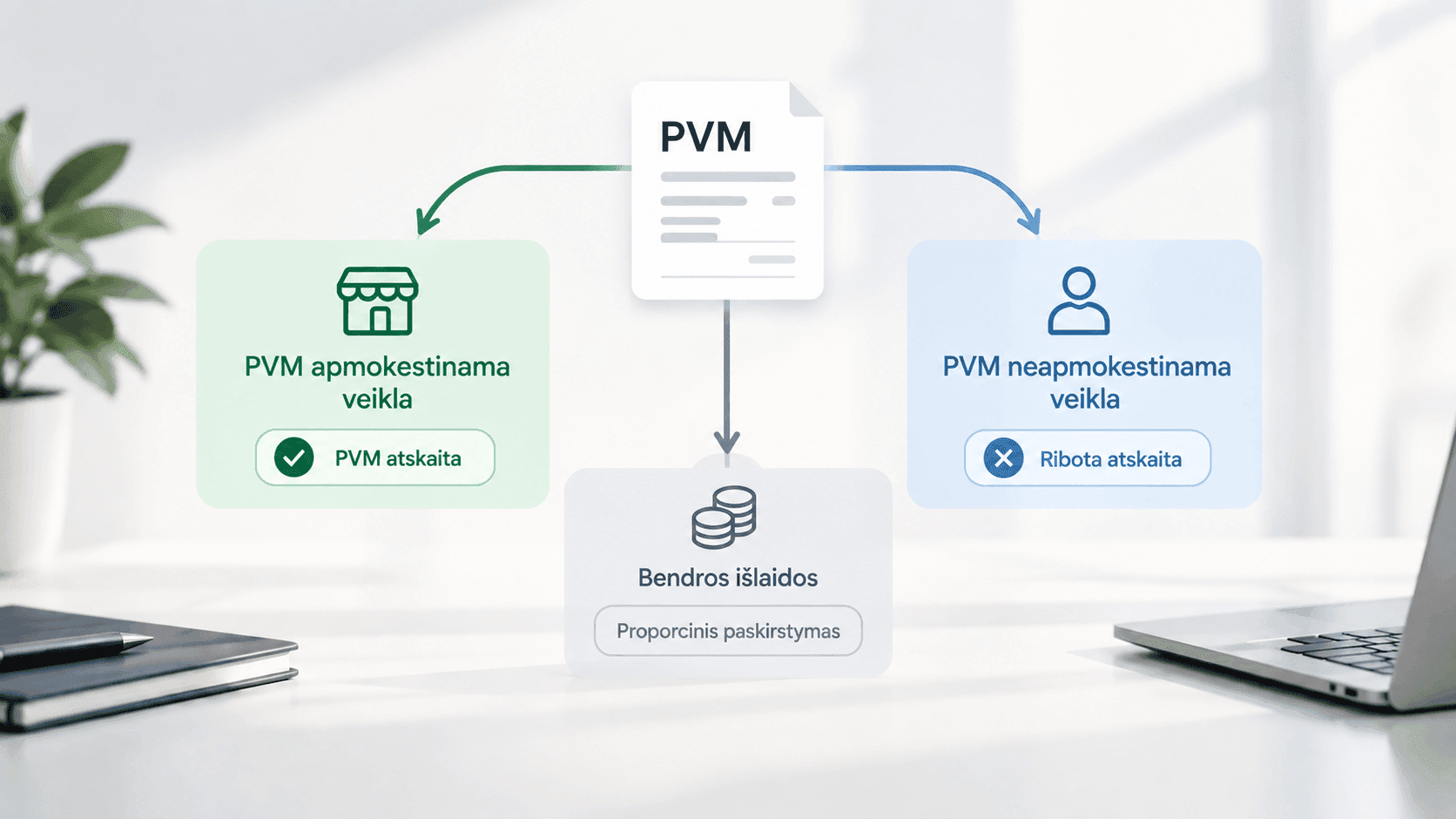
VAT MIXED ACTIVITY
When a VAT payer earns income from both VAT-taxable and VAT-exempt activities, it is considered to be carrying out mixed activity. If the VAT attributable to the VAT-exempt activity does not exceed 5 percent of the total input VAT amount, the entire input VAT amount is considered attributable to the VAT-taxable activity only, and VAT is deductible in full (100 percent).
Goods and services exempt from VAT are listed in the VAT Law:
- Goods and services related to healthcare (VAT Law, Art. 20)
- Social services and related goods (VAT Law, Art. 21)
- Education and training services (VAT Law, Art. 22)
- Cultural and sporting services (VAT Law, Art. 23)
- Activities of non-profit legal entities (VAT Law, Art. 24)
- Postal services (VAT Law, Art. 25)
- Radio and television (VAT Law, Art. 26)
- Activities of independent groups (VAT Law, Art. 261)
- Insurance services (VAT Law, Art. 27)
- Financial services (VAT Law, Art. 28)
- Special stamps (postage stamps, etc.) (VAT Law, Art. 29)
- Gambling and lotteries (VAT Law, Art. 30)
- Leasing of immovable property (VAT Law, Art. 31) and its sale or other transfer (VAT Law, Art. 32)
- Other special cases (VAT Law, Art. 33 and 331)
- Import of goods whose supply in Lithuania is exempt from VAT (Art. 34)
- Goods imported and then supplied to another EU Member State (Art. 35)
- Goods intended for diplomatic missions, consular posts, EU institutions, the missions established by them and representations of international organisations, as well as for the staff of such missions and consular posts and their family members, and goods intended for other persons (Art. 36)
- Goods carried by travellers (Art. 37)
- Imported gold (Art. 38)
- Re-imported goods (Art. 39)
No VAT is charged when supplying these goods or services.
VAT DEDUCTION
When carrying out mixed activity, VAT can be deducted in two ways: the direct method and the proportional method.
Under Art. 59 of the VAT Law, input VAT must first be allocated directly, and only where the accounting data make it impossible to allocate input VAT directly is the proportional method applied (VAT Law, Art. 60).
When allocating input and import VAT by the direct method, to the extent this is possible based on accounting data, VAT on goods or services acquired for the VAT-taxable activity is deductible in full (100 percent). These VAT amounts are entered in Box 25 “Input VAT on goods and services acquired” and Box 35 “Deductible VAT” of the VAT return. Meanwhile, input VAT on goods and services acquired for the VAT-exempt activity is not deductible, and these VAT amounts are entered only in Box 25 of the VAT return, while VAT allocated to the VAT-exempt activity is not included in Box 35 at all.
For example, a company carrying out mixed VAT activity earns VAT-exempt income from leasing non-residential premises and VAT-taxable income from selling office supplies. The company’s office and shop are located in a different building from the leased premises, so the accounting data make it possible to determine precisely the VAT amounts on costs attributable to the leased premises and the VAT amounts on the goods acquired for sale.
However, cases where costs can be clearly separated between the VAT-taxable and VAT-exempt activities are rare, so all other costs that cannot be allocated by the direct method are deducted using the proportional method. Under this method, a VAT deduction percentage must be calculated, which is then entered in Box 28 of the VAT return.
The VAT deduction percentage is calculated using the following formula:
VAT deduction % = Income from VAT-taxable activity / (Income from VAT-taxable activity + Income from VAT-exempt activity) × 100
The resulting percentage is the deductible share. For example, if the result is 65 percent, this figure is entered in Box 28 of the VAT return, and accordingly only 65 percent of input VAT is refunded. The deductible share applied in the reporting period is calculated based on the actual data of the preceding reporting period, i.e. the deductible share for 2026 is calculated based on 2025 data. Income is included in this formula based on the VAT invoices issued in that year. It is also important, when calculating this percentage, to assess and exclude any one-off transactions, as they can significantly distort the deductible share. For example, if a company decides to buy a new car and sell an old one, and the company’s main activity is not selling cars, the income from selling the car is not included when calculating the VAT deduction percentage.
To make it easier to picture how the proportional VAT deduction method is applied, we provide a couple of examples below.
EXAMPLE 1.
Lithuanian VAT payer UAB “UAB” carries out mixed activity and applies a 65% deduction percentage. It acquired goods worth EUR 15,000, intended for mixed activity. The VAT amount on the goods is EUR 3,150.
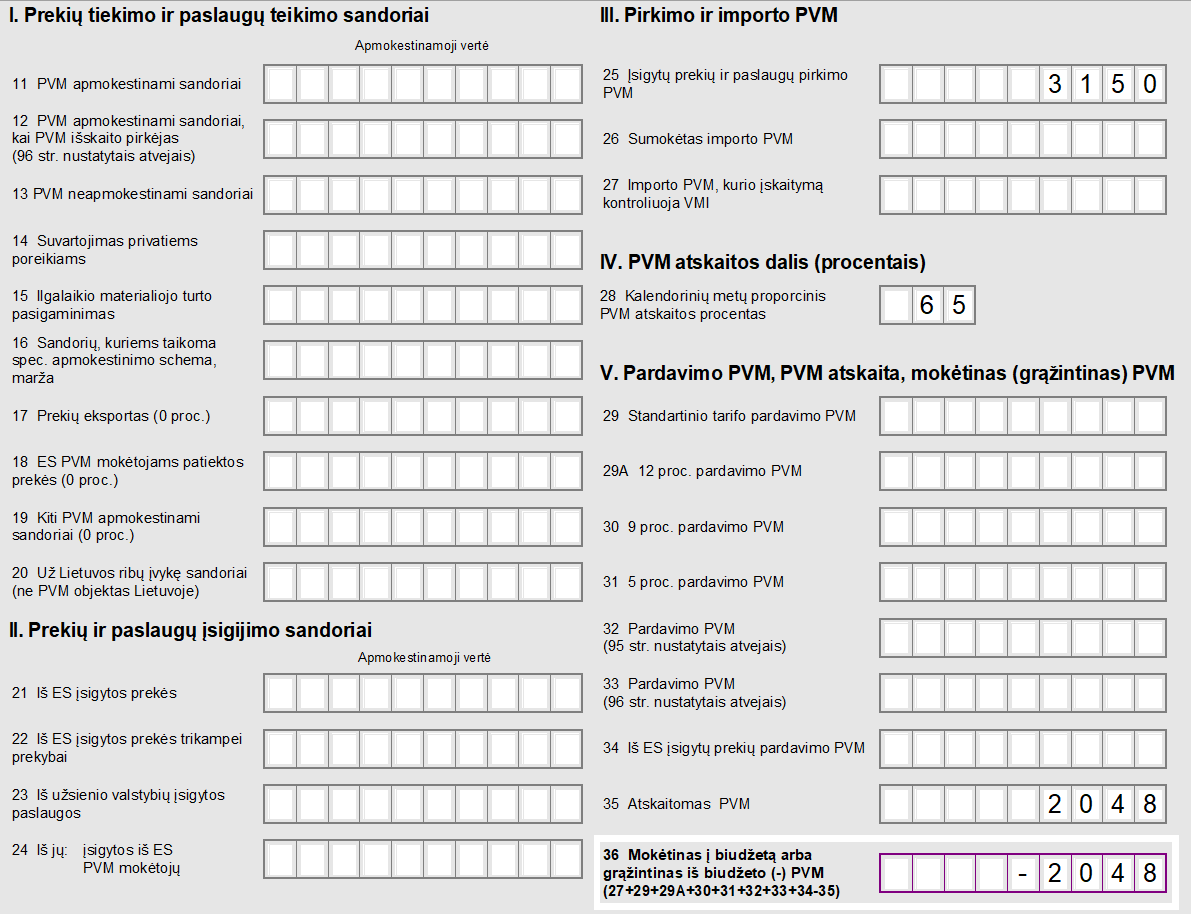
Entries recorded in the VAT return (FR0600):
- Box 25: EUR 3,150 (calculated VAT)
- Box 28: 65% (calendar-year VAT deduction percentage)
- Box 35: EUR 2,048 (deductible VAT, calculated as: 3,150 × 65 / 100 = 2,048)
EXAMPLE 2.
Lithuanian VAT payer UAB “UAB” carries out mixed activity and applies a 65% deduction percentage. It acquired goods worth EUR 15,000, intended for resale (i.e. for the VAT-taxable activity). The VAT amount on the goods is EUR 3,150.
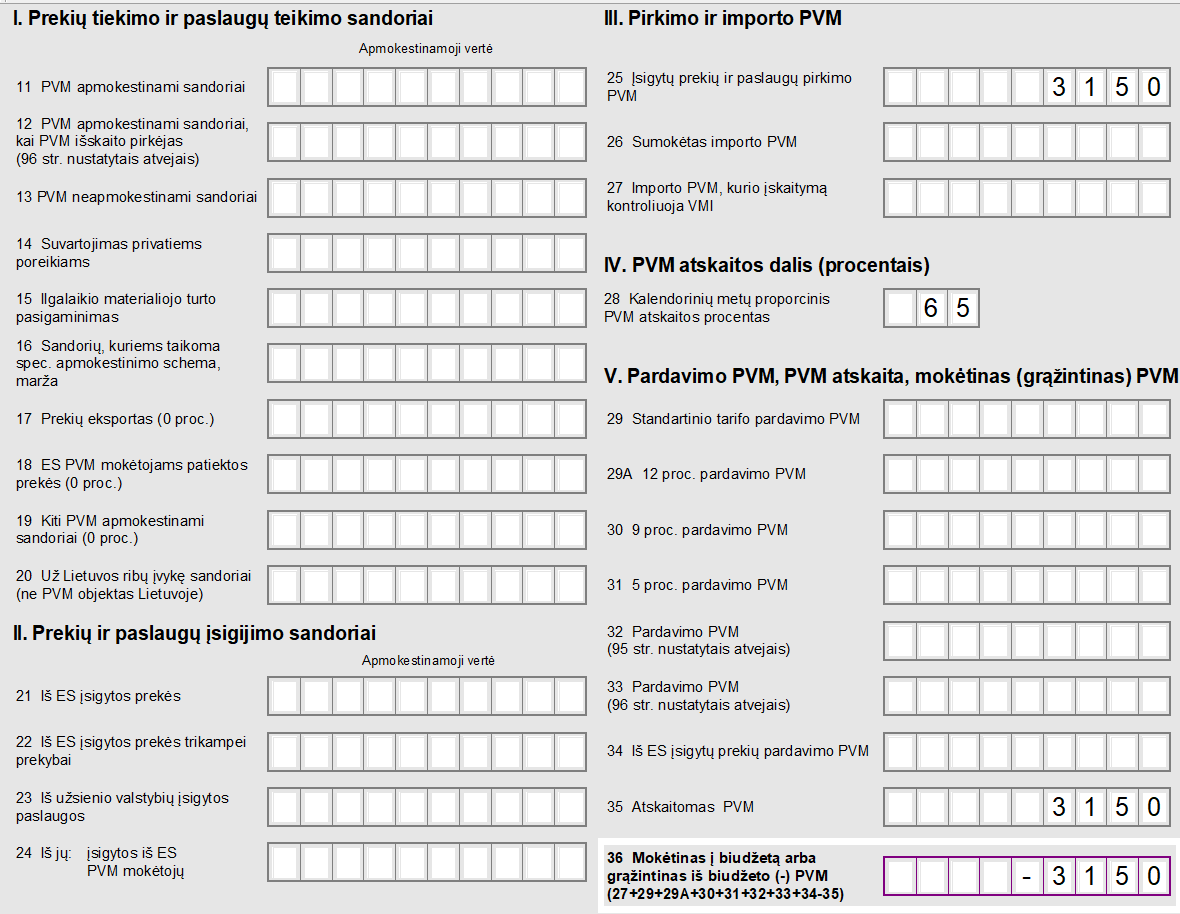
Entries recorded in the VAT return (FR0600):
- Box 25: EUR 3,150 (calculated VAT)
- Box 28: 65% (calendar-year VAT deduction percentage)
- Box 35: EUR 3,150 (full input VAT deducted)
MIXED VAT ACTIVITY NOT STARTING FROM THE BEGINNING OF THE YEAR
If a company starts carrying out mixed activity partway through the year, the deduction percentage is applied based on the projected figures for the current calendar year. VAT payers wishing to rely on projected figures for the current calendar year must notify the State Tax Inspectorate accordingly.
The request to agree the VAT deduction percentage is submitted via the My VMI (Mano VMI) self-service portal, by selecting: Services -> VAT and registration -> Request to agree the share of input and/or import VAT attributable to the VAT-taxable activity.
The request must be submitted no later than the 10th day of the month for which the VAT return will be filed, i.e. if the projected VAT deduction percentage is first entered in Box 28 of the VAT return for August, the request to agree the VAT deduction percentage must be submitted to the STI by 10 August (where mixed activity begins from the start of the calendar year, the request must be submitted no later than 10 January of the calendar year for which the VAT deduction percentage is determined based on projected figures for that year).
A VAT deduction percentage agreed with the STI must be used for all (or part of) the current calendar year, i.e. until the last day of the last month of the calendar year. Likewise, when calculating the VAT deduction percentage for the following calendar year, where mixed VAT activity did not begin from the start of the year, income for the entire year is taken into account. For example, if a company started carrying out mixed VAT activity in May 2025, then when calculating the VAT deduction percentage for 2026, income from 1 January 2025 onwards will be taken into account.
ANNUAL VAT RETURN FR0516
The annual VAT return FR0516 must be filed by:
- persons carrying out mixed activity, due to a change in the VAT deduction percentage;
- persons who temporarily use long-term tangible assets (referred to in Art. 67 of the VAT Law) in exempt activity;
- natural persons, due to a change in the VAT deduction percentage.
If the change between the share of VAT deducted in a given year and the actual VAT deduction percentage for that same year is less than 5 percent, the VAT deduction does not need to be adjusted in the annual VAT return. Likewise, if a VAT payer applied a lower VAT deduction percentage than the one calculated based on the actual figures for the calendar year, and after adjusting the VAT deduction would be entitled to a refund from the budget of an under-deducted VAT amount, the VAT payer has the right to file the annual VAT return even where the above VAT deduction percentages differ by less than 5 percent.
However, it is important to note that the difference is calculated in percentage terms. For example, suppose the deductible VAT share based on projected 2025 figures was 80 percent, and the deductible VAT share based on actual 2025 figures was 85 percent. It might appear that the difference is 5 percentage points and that the annual VAT return would not need to be filed, but the actual difference is 6.25 percent (calculated as 85-80/80×100 = 6.25), so the FR0516 return must be filed.
The annual VAT return FR0516 must be filed by 1 October of the following calendar year, i.e. the return for 2025 must be filed by 1 October 2026.
In summary, a company carrying out mixed activity should first allocate input VAT that is directly attributable to the VAT-taxable activity (VAT deductible in full) and to the VAT-exempt activity (VAT not deductible), and for goods and services that, based on the accounting data, cannot be directly attributed to either the VAT-taxable or the VAT-exempt activity, input VAT is allocated and deducted on a proportional basis.
If you have any questions regarding the accounting of mixed VAT activity or the application of the VAT deduction percentage, please contact your accounting and tax specialists – we are ready to help you account for and declare VAT correctly.